My MCP Scanner Scored 0 of 2 on a Real CVE. Here Is What Found It Instead
Key takeaways
- mcpscan 0.21.0 (30 rules) reported 7 findings on mcp-atlassian v0.16.0, a release with two published CVEs. None of the 7 was a real bug and neither CVE was found.
- The patched v0.17.0 got exactly the same 7 findings, so the report could not tell the vulnerable release from the fixed one.
- A manual trace from a caller-controlled path to a file write with no base-directory check found the 4 sites that upstream patched in 0.17.0.
- mcpscan 0.22.0 adds a small AST pass per Python function. It flags the two write sinks in v0.16.0 as HIGH and reports no MCP007 finding on v0.17.0.
- It still misses a path passed through several functions, a check that lives in the caller, and the SSRF CVE.
sooperset/mcp-atlassian is an MCP server for Jira and Confluence with 6,139 stars on GitHub. Version 0.16.0 has two published CVEs, one of them critical. I maintain mcpscan, a static scanner for MCP servers, and back in September I extended its path traversal rule to cover file writes after reading about the critical one. This week I ran the scanner against the vulnerable release itself, and it found neither CVE.
TL;DR
- mcpscan 0.21.0 reported 7 findings on mcp-atlassian v0.16.0. None was a real bug. It missed CVE-2026-27825 (file write, CVSS 9.1) and CVE-2026-27826 (SSRF).
- The patched v0.17.0 got the same 7 findings, line for line.
- Reading the code by hand, following each path parameter to the place it gets written, found the 4 sites upstream fixed in 0.17.0.
- mcpscan 0.22.0, released today, flags the two vulnerable write sinks as HIGH and has no MCP007 finding on the patched release. It still does not see the SSRF, and it loses track of a path that passes through several functions.
The two CVEs
| CVE | Severity | What | Fixed in |
|---|---|---|---|
| CVE-2026-27825 | Critical, CVSS 9.1 | Arbitrary file write leading to code execution, through the unconstrained download path in confluence_download_attachment | 0.17.0 |
| CVE-2026-27826 | High | SSRF through the X-Atlassian-Jira-Url and X-Atlassian-Confluence-Url headers | 0.17.0 |
The advisory range for the file write is <0.17.0. The fix calls validate_safe_path(...) before every download is written.
What mcpscan 0.21.0 reported
I scanned src/ of the v0.16.0 tag: 94 files, about 6 seconds, 30 rules, 7 findings.
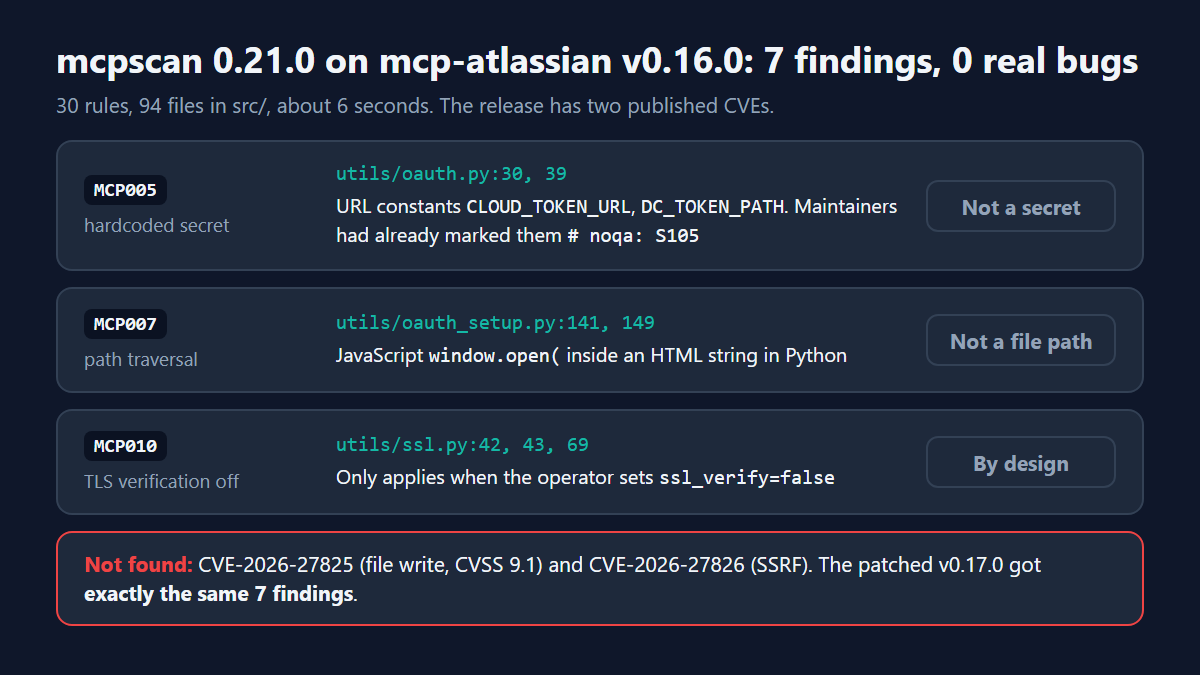
Going through them one by one:
- Two MCP005 “hardcoded secret” hits in
utils/oauth.py:30and:39. They areCLOUD_TOKEN_URLandDC_TOKEN_PATH, an OAuth endpoint URL and a path. The maintainers had already marked both# noqa: S105, the same complaint from their own linter. - Two MCP007 “path traversal” hits in
utils/oauth_setup.py:141and:149. Both are JavaScriptwindow.open(calls inside an HTML page that Python builds as a string. My regex sawopen(and fired. - Three MCP010 “TLS verification disabled” hits in
utils/ssl.py:42,:43and:69. That code only runs when the operator setsssl_verify=false, so it is there by design.
Then I scanned v0.17.0, the release that fixes both CVEs. Same 7 findings, same files, same lines. Whatever the report was measuring, it was not the security of the download path.
What found it: a manual trace
The question I asked by hand was narrow. For every function that writes a file, where does the path come from, and does anything check that it stays inside a base directory before the write?
In src/mcp_atlassian/confluence/attachments.py on v0.16.0 the answer takes a few lines to find:
def download_attachment(self, url: str, target_path: str) -> bool:
    ...
    # Convert to absolute path if relative
    if not os.path.isabs(target_path):
        target_path = os.path.abspath(target_path)

    # Create the directory if it doesn't exist
    os.makedirs(os.path.dirname(target_path), exist_ok=True)

    # Use the Confluence session to download the file
    response = self.confluence._session.get(url, stream=True)
    response.raise_for_status()

    # Write the file to disk
    with open(target_path, "wb") as f:
target_path is a parameter. os.path.abspath makes it absolute and does nothing to limit where it points. os.makedirs creates whatever directory is missing. Line 198 writes the downloaded bytes there. jira/attachments.py has the same shape, with the write at line 50.
Following the callers turned up two more functions, download_content_attachments and download_issue_attachments, which take a target directory and write through those two. That makes 4 sites, and they are the same 4 that upstream patched in 0.17.0.
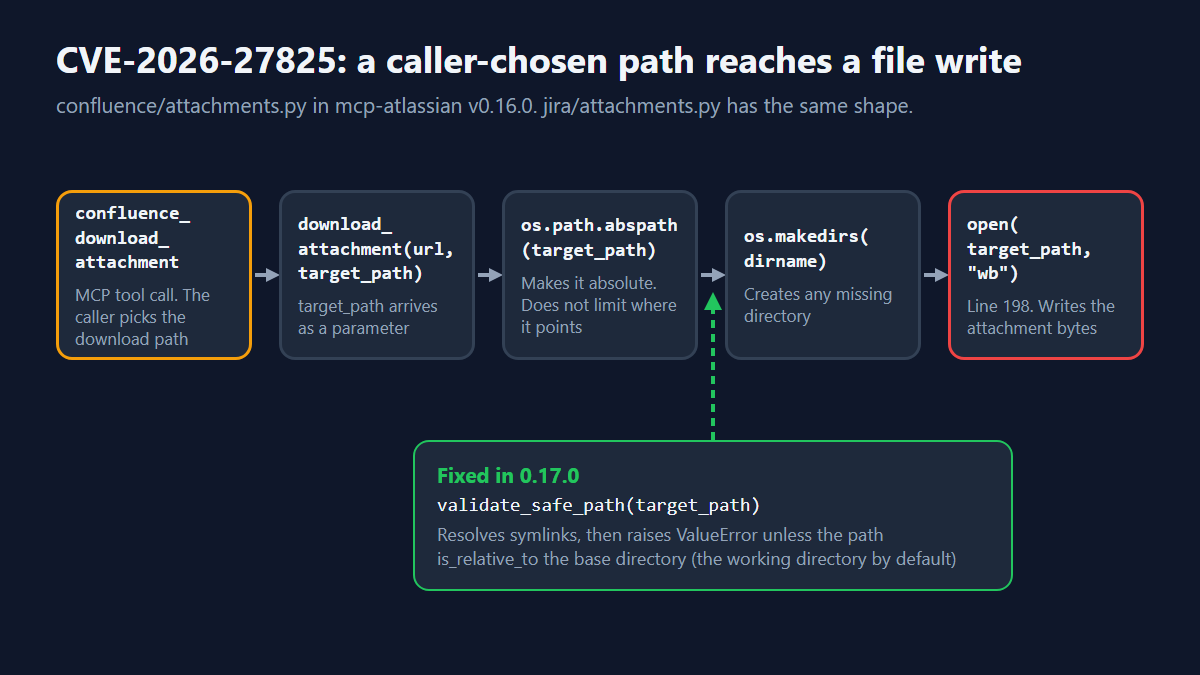
In download_attachment the upstream fix is one call after abspath:
    # Guard against path traversal (resolves symlinks)
    validate_safe_path(target_path)
validate_safe_path resolves the path, symlinks included, and raises ValueError unless the result is_relative_to the base directory, which defaults to the working directory.
Why MCP007 missed it
The September change added write sinks to MCP007, but the rule still only fired when the path was interpolated on the same line as the sink. It catches open(f"{base}/{name}", "w"). The vulnerable line here is with open(target_path, "wb") as f:. There is nothing on that line for a regex to object to. The danger is that target_path came in from the caller at the top of the function and nothing checked it in between, and a line-based rule has no view of that.
The fix in mcpscan 0.22.0
mcpscan 0.22.0 adds a small ast pass for each Python function, next to the existing line regex:
- Start from the function’s parameters. Names assigned from a parameter
p, fromPath(p)or fromos.path.abspath(p)count as the same value. - Look for a write sink that receives one of those names:
openwith aw,a,xor+mode,write_text,write_bytes,shutil.copy,copy2,copyfileandmove, andos.renameandos.replace. - If the function has no boundary check, report it as HIGH. A boundary check is
realpathorresolvefollowed bystartswith,is_relative_toorcommonpath, or a call to anything named like*safe_path*or*validate_path*.
It also stopped matching window.open(.
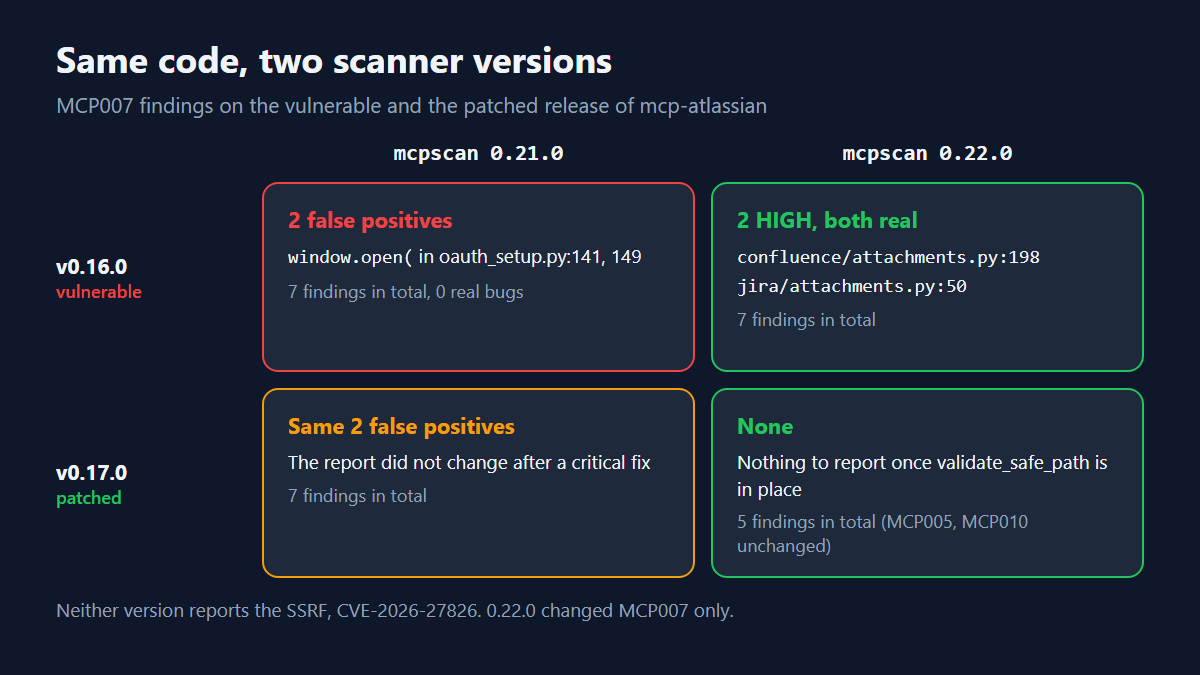
On v0.16.0, MCP007 now reports confluence/attachments.py:198 and jira/attachments.py:50 as HIGH. On v0.17.0 it reports nothing, and the total drops to 5: the unchanged MCP005 and MCP010 findings. The release has 8 new tests, the full suite passes 266 of 266, and mcpscan’s scan of its own code is clean.
Getting that self-scan clean needed one suppression. drift.py writes mcpscan’s own baseline file to a path that arrives as a parameter, which is exactly the shape the new check looks for:
with open(path, "w", encoding="utf-8") as fh: # mcpscan: ignore[MCP007] baseline path is ours, not tool inputThat is the noise the check will add elsewhere. In an MCP server, a path parameter often comes from a tool call, and an unchecked write to it is the bug. In a generic utility or a CLI that writes where its own user told it to, the same pattern is fine, and you will be suppressing it.
What it still cannot do
- A path that passes through several functions before the write is not tracked. The pass looks at one function at a time. It flags the two functions that do the writing in mcp-atlassian, while the two download-all functions that pass a directory down to them get no finding of their own.
- A check that lives in the caller is not recognised. If the caller validates the path and the writing function does not, 0.22.0 still reports the writing function.
- The SSRF is still missed. 0.22.0 changed MCP007 and nothing else, so on this release it gets 1 of the 2 CVEs, the file write.
- The “14 of 14, zero false positives” benchmark I published earlier measured synthetic fixtures I wrote myself. It says nothing about detection on real code, and this run shows the difference.
Where the scanner fits in a review
Automated MCP scanners are sold for about $0.25 per server on Apify. That price is fine for what a scanner does. In this case the review was the human trace: take every input a tool call controls, follow it to the file system, the network or a shell, and look for what stops it. The scanner is the second pass, useful for the code you did not get to and for catching the same mistake when it comes back.
mcpscan 0.22.0 is on PyPI as mcpscan-cli:
pip install -U mcpscan-cli
mcpscan ./path-to-an-mcp-server
If you run an MCP server and want that trace done before a release, I offer a free preflight.
Frequently asked questions
- Which mcp-atlassian versions are affected by CVE-2026-27825?
- The advisory range is below 0.17.0. It is a critical arbitrary file write, CVSS 9.1, that can lead to code execution through the unconstrained download path in confluence_download_attachment. Version 0.17.0 fixes it by calling validate_safe_path before the write.
- Why did mcpscan 0.21.0 miss the file write?
- Its path traversal rule, MCP007, only fired when the path was interpolated on the same line as the write. In mcp-atlassian the path arrives as a function parameter, and the line that writes is just open(target_path, "wb").
- Does mcpscan 0.22.0 catch CVE-2026-27826, the SSRF?
- No. 0.22.0 changes MCP007 only. Its other findings on v0.16.0 are the same MCP005 and MCP010 hits as before, and none of them points at the header-based SSRF.
About the author

Security Engineer & Technical Writer
Security engineer and technical writer based in Batam, Indonesia. I review and harden MCP servers and AI agents, build security automation, and write up what holds and what fails. I also train on DNS security as a PANDI .id Academy trainer.
Related articles
-
8 min read
I Wrote an MCP Server Auth Test Harness for the 2026-07-28 Spec. Here Is What Broke First
Ten tests mapped to the MCP 2026-07-28 authorization spec. A quickstart-style server passed 2. Four fixes and two policy changes got it to 10.
- MCP Security
- Security Engineering
-
10 min read
I Traced 29 CVEs in One MCP Server to 4 Root Causes
29 mcp-atlassian CVEs traced to 4 root causes: DNS rebinding, credential fallback, tool allowlist and file_path. The safe version floor is 0.23.1, not 0.22.0.
- MCP Security
- Security Engineering
-
10 min read
MCP Servers Had a Rough 48 Hours: 4 Unauthenticated CVEs
Four MCP servers published unauthenticated CVEs in about 35 hours, plus LiteLLM's KEV-listed bypass. Fixed versions and a checklist to audit your MCP servers.
- MCP Security
- Security Engineering
All writing | RSS | Markdown